Wednesday, July 7, 2010

Inflated Bandhs


I was reading an article by Deepak Shenoy and after reading that article I could not resist myself from penning down by view points…….......

Last Monday was "bandh", railing against the fuel price hike and 'mehengai' (rising prices).

We all know that the three basic necessities of "aam aadmi" - the common man are Food, Cloth and Shelter. The frustration seems to be over what we are seeing in the agricultural markets - prices of agri-products have risen tremendously over the last two years and that seems to be affecting the sentiment of the common man. Increase in rent or property prices every year and even for increase in clothing prices should have elicited calls for “bandhs” every year. But food seems a higher inflation fear which I failed to understand that why the common man does not reacts on increase in prices for the other two basic necessities.

I am not in support for calling “bandhs” but we should at least show our concerns for increase in rent or property and clothing prices.

Now let's take fuel prices. They were recently raised because international fuel prices have been going up....but a major percentage of fuel prices are taxes. If the government wanted to keep fuel prices at the same level, they could have reduced the tax and the subsidy at the same time.
(Image source: Beinoman.com)

The Sales Funnel


Keeping control of your sales pipeline.

With the idea of the Sales Funnel, one uses the metaphor of a funnel (wide at the top, narrow at the bottom) to monitor the sales process.

At the top of the funnel are the "unqualified prospects" - the very many people who might need your product or service, but to whom you've never spoken. At the bottom of the funnel, many sales and delivery steps later, you have people who have received delivery of your product or service and have paid for it.

The metaphor of the funnel is used because people drop away at each stage of a long sales process: For example, many of your unqualified prospects may have existing suppliers with whom they're very satisfied. Others may have needs which other competitors are better-placed to satisfy. Still others may love your products, but not have the budget to buy them.

The sales funnel is not a new tool for the management of the sales process. Most sales managers use it to understand the sales pipeline and its status. However, the sales funnel can be an important tool in improving performance. It can help us identify areas for improvement and understand what actions can help the sales and marketing process to both increase deal flow and lower the cost of sales. Different sales executives define the sales funnel in different ways.

Sales and marketing management can be more of a science and using the sales funnel can help us understand what is happening, and why and how we can improve the processes. The results can increase revenue while lowering the cost of sales.
(Image source: Seanseo.com)

Tuesday, June 15, 2010

The 4 Ps of Innovation


I was reading a blog by Scott Anthony on 4 Ps...... really interesting. Scott Anthony is the Managing Director of Innosight Ventures and has written three books on innovation.

Any marketer can quickly rattle off the so-called "4 Ps" of marketing (product, price, place, and promotion). Innovators should also be able to quickly recite the 4 Ps that capture their idea's potential: population, penetration, price, and purchase frequency.
Companies looking at a specific revenue target can simply multiply the addressable population, the penetration of that population, the price per purchase, and the purchase frequency to get to annual revenues. Typically he suggests people try to be quite precise about their target population, give their best estimate based on in-market analogies of the pricing and purchase frequency, then determine what penetration they would need to hit their targets.

This deceptively simple calculation neatly captures many of the elements of an idea's business model. Does the idea target a niche or a mass population? Is it an occasional or frequent purchase? What channel would support the target price point? What kind of support would be necessary given the purchase frequency?

Once you do the 4P calculation (and of course, if you add in a fifth — profit margin — you can look at profits instead of revenue), the focus shifts to finding systematic ways to determine whether the assumptions behind the calculation have any hope of being true.

The deep thinking that goes into creating complicated spreadsheets for ideas can be very useful. But it also can be a way to mistake motion for progress. Make sure you can answer the simple questions before you worry about the complicated ones.

(Image source: Business-strategy-innovation.com)

Friday, June 11, 2010

Emotional Response Marketing


Emotions are one of the most powerful influences we have. Think back for a minute and try to think of anything that you've purchased where your emotions haven't played a major part in the decision process. We use our emotions to help visualize ourselves benefiting from the purchase of a particular product or service. When was the last time you bought something that there weren't any emotions attached to the purchase? I don't think you'll find even one instance!

Emotions are brought to the surface by taking the benefits of your product or service and relating each one of them to a particular emotion. Since every product or service fills a particular need, you'll have to find the benefits and emotions of ownership for yours.

Here's a simple, three step process to help you define the benefits and emotions for your product or service:

1. List the Benefits of Your Product or Service
You want to be able to make a list of the benefits your particular product or service has to offer your target market. This should have already been done when you were doing your market research on your product or service. But if you didn't, take ample time here to know just what benefits your product or service is going to provide your prospective customers.

2. Take Each Benefit and Match the Emotions It Creates
Now take each benefit and match up the emotions that your potential customers are going to experience when they purchase your product or service. Remember not all of the emotions are going to be positive ones. You want to focus on the positive emotions as they are much more powerful.

3. Create Exciting Words and Phrases to Relate These Emotions
You want to create phrases and wording in your advertisements and sales letters that will bring out the emotions attached to the benefits in your prospects mind as they're reading your advertisements and sales letters. Remember you're tying to get on a personal basis with your prospect so don't forget to TALK WITH THEM & NOT AT THEM. Think as if you're sitting with your prospect and talking to them when writing your advertisements and sales letters so you'll be able to relate to them on a one to one basis. Use you and your, instead of me, or I in your advertisements and sales letters.

If you forget everything else, remember this: "The Buying Decision Is ALWAYS Based On An Emotional Response!"

(Source: Internet Marketing Issues)
(Image source: Drdavidwick.com)

Wednesday, June 9, 2010

Nuclear Liability Bill


Monday’s verdict in the Bhopal gas tragedy case has made the present government to rethink against rushing to push the Civil Liability for Nuclear Damage Bill, which aims at creating a regime for compensation and accountability-fixing in the case of a nuclear accident. I personally think that the nuclear liability Bill should not be pushed in its present form.

Nuclear power, which is the fourth largest source of electricity in India at present, accounts for just four percent of total electricity generation capacity. Within next 25 years, India aims to increase this to nine percent of the total generated power. As a society, we want certain benefits, and we want risk takers to figure out better/faster/cheaper ways to obtain them. But if we're going to walk higher wires, we need stronger nets. It is inevitable that system will grow more complex, and that human beings will continue to take risks to meet their immediate objectives. The decision makers need to address the complex issues in simple ways.

(Image source: Canarytrap.in)

Thursday, May 27, 2010

Brand Community


A brand community is a community formed on the basis of attachment to a product. Recent developments in marketing and in research in consumer behavior result in stressing the connection between brand, individual identity and culture. Among the concepts developed to explain the behavior of consumers, the concept of a brand community focuses on the connections between consumers. A brand community can be defined as an enduring self-selected group of actors sharing a system of values, standards and representations (a culture) and recognizing bonds of membership with each other and with the whole.

Marketers in a variety of industries are trying to increase customer loyalty, marketing efficiency, and brand authenticity by building communities around their brands. Few companies, however, understand what brand communities require and how they work. For instance, many managers think of a brand community in terms of marketing strategy. In fact, for a community to have the greatest impact, it must be framed as a corporate strategy. Another common misconception is that a brand community exists to serve the business. An effective brand community exists to serve its members, who participate in order to fulfill many kinds of needs, such as building relationships, cultivating new interests, and contributing to society. Strong communities work to understand people's needs and to engage participants by offering a variety of roles. Finally, managers often think that a brand community must be tightly controlled. In reality, a robust community defies managerial control.

(Image source: Metaphorstudio.com)

Monday, May 17, 2010

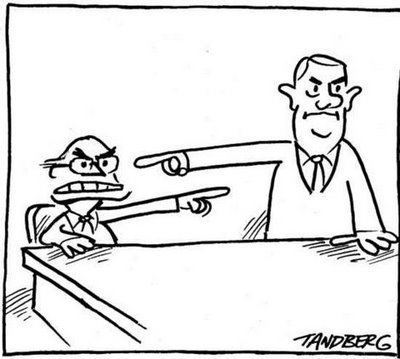
How to Stop the Blame Game?


Playing the blame game never works. A deep set of research shows that people who blame others for their mistakes lose status, learn less, and perform worse relative to those who own up to their mistakes. Research also shows that the same applies for organizations. Groups and organizations with a rampant culture of blame have a serious disadvantage when it comes to creativity, learning, innovation, and productive risk-taking.

That's why creating a culture of psychological safety is one of the most important things a leader can do.

A set of recent studies showed that merely being exposed to someone else making a blame attribution for a mistake was enough to cause people to turn around and blame others for completely unrelated failures. This is different from the "kick-the-dog" phenomenon, where a person is more likely to blame the person below them in the hierarchy when they, themselves, have been blamed by a higher-up. Instead, it appears that all you have to do to "catch" the blame virus is to be exposed to someone else passing the buck.

How to prevent the spread of blame in one's organization??? Here are a few practical steps:

• Don't blame others for your mistakes - The temptation is huge to point the finger elsewhere when you make a mistake. Resist it. Not only will you gain respect and loyalty from your followers, you'll also help to prevent a culture of blame from emerging.

• When you do blame, do so constructively - There are times when people's mistakes really do need to be surfaced in public. In these cases, make sure to highlight that the goal is to learn from mistakes, not to publicly humiliate those who make them.

• Set an example by confidently taking ownership for failures - Our findings showed that blame was contagious, but not among those who felt psychologically secure. So try to foster a chronic sense of inner security in order to reduce the chances that you'll lash out at others.

• Always focus on learning - Creating a culture where learning — rather than avoiding mistakes — is the top priority will help to ensure that people feel free talk about and learn from their errors.

• Reward people for making mistakes - Some companies are actually starting to incentivize employees to make mistakes, so long as the mistakes can teach valuable lessons that lead to future innovation.

(Source: Harvard Business Review)